
The complete guide
Choosing a Galvanised Manhole Cover, A Practical Buyer's Guide
The problem nobody plans for
Manhole covers get ignored until they fail. Then it happens all at once. The lid starts rocking when you step on it. A corner rusts through. The mower catches the raised edge for the third time this summer. Or worst of all, someone lifts it to rod a blocked drain and the whole thing crumbles apart in their hands.
Older domestic covers were usually cast concrete or unprotected steel. Concrete cracks along its reinforcement and gets heavier every year with soaked-in water. Bare steel sitting in a wet chamber rusts from both sides. Neither ages well in a garden that gets rained on for a couple of decades.
A galvanised manhole cover fixes the corrosion side of that problem. Galvanising is a zinc coating bonded to the steel. Zinc corrodes in preference to the steel underneath, so the coating takes the weather while the structure stays sound. It's the same reason garden gates, cattle troughs and scaffold fittings are galvanised. It isn't glamorous engineering, but it works, and it works for a long time with almost no attention from you.
How this cover is put together
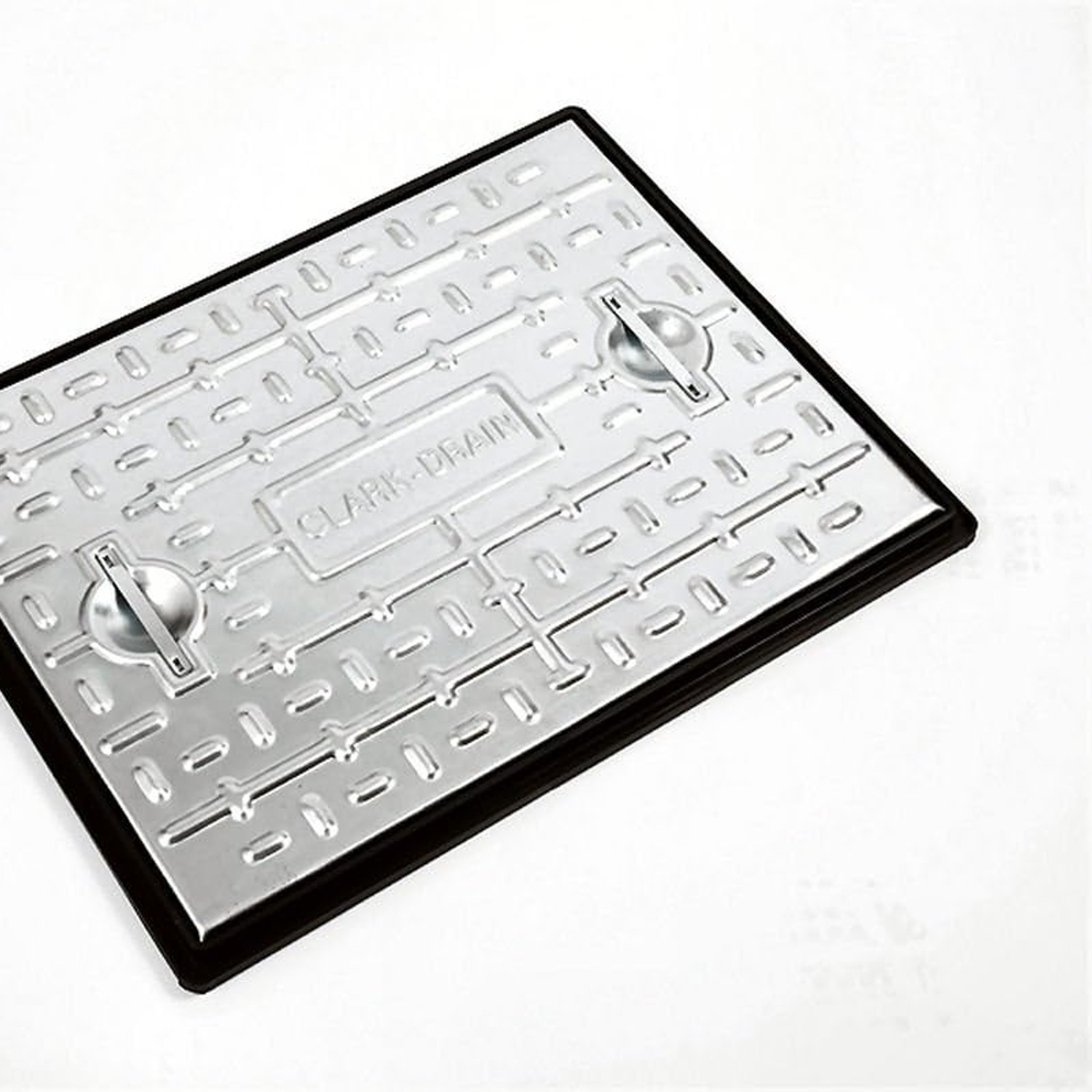
Two parts arrive in the box. The first is the cover itself, a solid-top galvanised steel lid. Solid top means the visible surface is the steel, not a tray you fill with paving. The second is a black polypropylene frame, which is the part that gets bedded into the top of your chamber.
That plastic frame is a deliberate choice rather than a cost saving. The frame is the component permanently in contact with mortar and damp ground, and that's exactly where old steel frames used to rot away. Polypropylene doesn't rust. It also gives a clean, defined black border once the job is done, which looks far tidier than a ragged concrete lip.
The clear opening is 600 x 450mm. That's the hole you can actually get through, and it's one of the most common sizes for domestic inspection chambers. The frame external size is 663 x 513 x 30mm, so allow that extra footprint around the opening when you're working out how it sits against paving or a path edge.
Load rating is 2.5 tonne. Total weight of the unit is 3 kg, which is light enough to carry in one hand.
What 2.5 tonne actually means
Load ratings confuse people, partly because the number sounds enormous compared with a person. A 2.5 tonne rating is a pedestrian and light domestic duty rating. It covers people walking, wheelbarrows, garden furniture, bikes and an ordinary family car on a driveway.
What it doesn't cover is commercial traffic. A skip lorry, a delivery truck, a concrete mixer or plant machinery all put loads through a single wheel that go well past what a domestic cover is built for. If your chamber sits on a shared access road or anywhere a heavy vehicle turns, you need a higher rated cover and probably professional advice on the chamber below it too.
There's a second thing worth knowing. A cover only performs to its rating if the frame is fully supported. A frame bedded on a thin smear of mortar, or spanning a crumbling chamber wall, will flex no matter how strong the lid is. Most cover failures I have seen were installation failures, not product failures.
Who this suits
If you've a standard domestic inspection chamber with a 600 x 450mm opening, in a garden, a path, a patio or a driveway used by cars, this is a sensible match. It's a common replacement for a broken concrete lid on a house built any time in the last fifty years or so.
It also suits anyone who has to open the chamber occasionally. The integral lifting handles matter more than the spec sheet suggests. Levering a lid up with a screwdriver is how coatings get chipped and fingers get pinched. Handles turn a two-minute wrestle into a straight lift.
It's less suitable in three situations. If you want the cover to disappear into block paving or slabs, you need a recessed tray cover, not a solid top. If you need a sealed or odour-proof lid for an enclosed or internal position, look for one described specifically as sealed, since that's not stated for this product. And if your opening isn't 600 x 450mm, buy the size that matches rather than trying to make it work.
Measuring before you buy
This is the step people skip and then regret. Take the old cover off and measure the clear opening, the actual hole, not the outside of the old frame. Measure both directions and write the numbers down.
Then check the depth you have to play with. This frame is 30mm high. If you're setting it flush into a patio, that dimension needs to work with your slab thickness and mortar bed. If it's going into a lawn or a gravel bed, you've more flexibility.
Have a look at the chamber walls while the lid is off. Loose brickwork, missing mortar joints or a cracked top course all need sorting before you bed a new frame. It's a small job at that stage and an annoying one later.
Fitting it
The short version of the job goes like this. Lift out the old cover and frame, chip away the old mortar bed, and clean the chamber top back to sound material. Mix a stiff sand and cement mortar. Bed the new frame on it, working it down until it's level in both directions and sitting at the height you want relative to the surrounding surface.
Check the level twice. A frame that's even slightly twisted will hold the cover unevenly and it'll rock forever after. Leave the mortar to cure properly before you drop the cover in and definitely before anything drives over it.
Wear gloves. Old covers often have corroded edges that are sharper than they look, and there's usually a fair amount of grit and old mortar to handle.
Keeping it in good shape
Maintenance is close to nothing, but a few minutes now and then pays off. Sweep grit out of the frame rebate, because a single stone in there will hold the lid proud and make it rock. Rinse mud off the steel and let it dry.
Before winter, clear leaves and soil from around the frame edge so surface water runs away instead of sitting on the cover. If the coating gets scratched down to bare metal, brush the area clean and dab on some cold galvanising or zinc-rich paint. That takes two minutes and stops a rust spot becoming a rust patch.
Always lift by the handles. It sounds obvious, but the habit of jamming a spade under one edge is what damages covers over time.
The short version
You're buying a solid-top galvanised steel lid in a black polypropylene frame, sized to a 600 x 450mm clear opening, rated to 2.5 tonne, weighing 3 kg, with lifting handles built in. It suits gardens, paths, patios and domestic driveways. It doesn't suit heavy vehicle areas or situations where you need a sealed lid or a paving-filled recess.
Measure your opening first. Bed the frame level on a proper mortar bed. After that, it's one of those jobs you do once and stop thinking about, which is exactly what you want from a manhole cover.